I thought about not writing the post , however I I convinced myself that Knowing about the existence of a potential bug might help in the future
2 Likes
Sometimes bugs come with too little data about them to take proper actions against them…
2 Likes
Thanks to this I was able to finally track down the problem which was pretty silly in hindsight. I had forgotten that the multicellular organelle category is entirely hidden in microbe stage so I was incorrectly trying to check if an organelle was unavailable in the microbe stage and so the suggestion tried it.
That PR also addresses some other recent feedback where people were confused about what axon and myofibril did so in the future they’ll only be available in macroscopic.
5 Likes
Oh, so the multicellular category was present all the time in the editor but was just invisible and uninteractable for the player, right?
2 Likes
I finally had time to investigate this. I don’t have a reason why it ultimately ends up like that but I printed some extra info and found out that the suggestion auto-evo simulation does truly result in the nucleus giving the highest score. I don’t know why that really happens so I opened 2 issues:
4 Likes
An idea I had: could the organelle suggestor be changed so that it also shows the best organelle for you species in the patch you’re in? Because at the present pretty sure it shows the best organelle for your overall population, so if you have a large population in vents for example but migrated elsewhere, at the present the suggestor will generally show the best organelle for the vents population to add instead of your patch, which might be way different.
3 Likes
I mean the question is that what is the primary purpose of the suggestion feature? To me it is the answer to players complaining that they cannot make cells that auto-evo likes. So the fact that it suggests what makes your species do the best in auto-evo, is the goal in my eyes. So it is not meant to be a general gameplay helper that would make more sense if it told you what it thinks is the best organelle to add in the current patch.
5 Likes
I mean, it is important. If autoevo doesn’t think much of your species, a single death could be equal to a total extinction of the species even on normal difficulty. So if you don’t know how to improve your value in eyes of autoevo, the suggestor has a good say.
1 Like
Actually, I couldn’t let this just be so I tried one idea I had: removing the population clamp step from the suggestion. With that change the nucleus increasing the individual cost can no longer unfairly give more score, so with that change and your cell, I get the suggestion of nitrogenase instead of the nucleus:
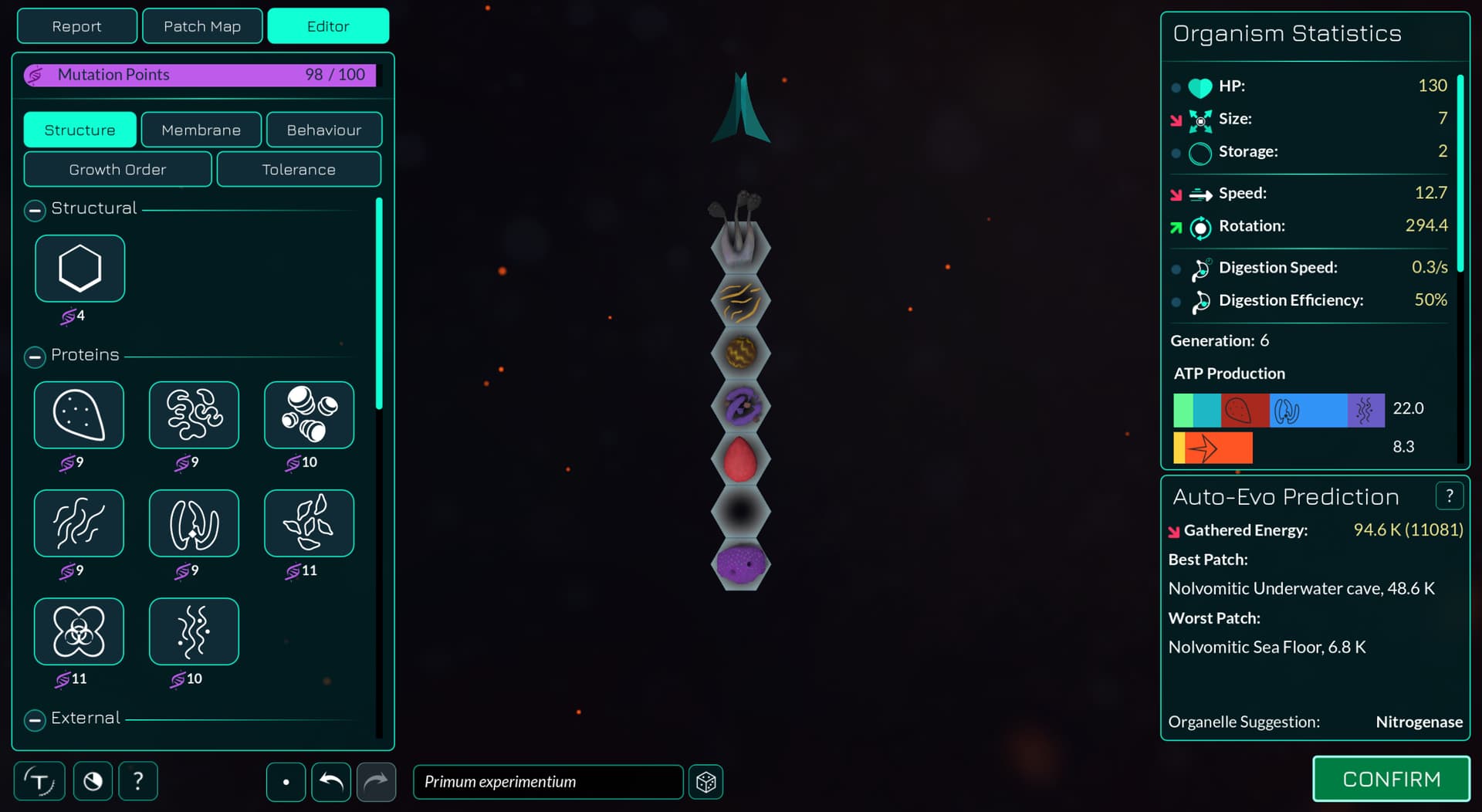
Which seems very good!
So I’ve made a PR (as this doesn’t seem to negatively affect the suggestions early in the game):
4 Likes
And so the suggestor has been leant (?) closer towards the player species.
Was that the last major 0.8.0 issue reported? Seems like so.
1 Like
I found chemosynthesis-based microbes completely unviable. It was nearly impossible to find a rich enough sulfide source to keep up with a single Chemosynthesizing Proteins This was a frustration I had in a previous version, but it’s still a problem in the current version.
Consider the following two organisms. The first has one Chemosynthesizing Proteins, and the other spaces are using Hydrogenase in the hopes that a more efficient glucose-use process will allow glucose storage to fill up and slow down the Chemosynthesizing Proteins. The second uses Rusticyanin in all of those spots and is otherwise identical

With the sulfide-based microbe, even when constantly moving through new material, any hydrogen sulfide concentration less than “quite a bit” means that not only does hydrogen sulfide storage not increase, but glucose storage depletes. The organism will die if all it has is a “a fair amount” region. In contrast, with the iron-based microbe, moving through any iron concentration above “little” increase the iron storage.
I’ve definitely noticed that the other people in this thread don’t seem to share my sentiment, so I have to wonder what I’m not picking up about chemosynthetic microbes in this game, but this state of affairs still feels hard to explain.
1 Like
There are 2 problems with iron.
First: While it starts off as seemingly the best source of energy in the game, when oxygen levels rise due to photosynthesis, iron becomes much less efficient.
Second: A good, populous iron dependent species will crowd the player away from their source of iron. Intraspecies competition is not well handled at this time.
As for sulfur, maybe try finding a patch with more in it?
Edit: Also, your first cell needs BOTH sulfur and glucose while your second ONLY needs iron. Have you tried an only sulfur cell?
1 Like
Doesn’t sulphur turn into glucose and only then glucose turns into atp through?
1 Like
I just want to be make sure you know that Chemosynthesizing Proteins, due to being suspended in Cytosol, allows you use both H2S and Glucose as separate energy sources. So you can go through clouds of Glucose to get what you need if there are no nearby clouds of H2S.
1 Like
The point of having chemoproteins is to use H2S anyhow through…
I’ll add that if there is no competition for hydrogen sulfide, the vent eruption events can skyrocket the hydrogen sulfide amounts to 100+ (where 20 is starting amount). That makes it much much more common to find it. Just yesterday someone posted a screenshot with a patch with 400+ hydrogen sulfide, so there are definitely situations I’d expect hydrogen sulfide to be overpowered even.
1 Like
Yeah, but the superhigh amounts will only last so long…
Still long enough to people to always post screenshots about it…
1 Like
…Before it inevidadably falls as species capitalize on the astronomic concentrations. I can guess they can go even higher if you play a “hermit cytoplasm”, preventing other species from splitting off through.
Are the concentration labels in the “at cursor” UI scaled with the level in the patch? If so, that is a definite UI trap – I would expect the patch level to affect how often clouds of the compound spawn, and what the peak concentration (“some”, “a fair bit”, etc) of each cloud is. I would not expect it to change the meaning of those concentration terms.
Chemosynthesizing Proteins make glucose from H2S. They do not make ATP directly – Rusticyanin is an anomaly in working that way. The intent of the microbe is to use H2S as the sole method of making glucose, and then using that glucose to make ATP
A primary aspect of the game to me is that availability of free glucose decreases over time. If a microbe can’t thrive on H2S without free glucose, then it cannot thrive on H2S.
There has been a definite misunderstanding of my feedback – presumably because I couldn’t remember that “cloud” was the term for the regions with a compound in them. I am not having trouble finding H2S clouds. I am saying that the microbe is actively moving through an H2S cloud, absorbing H2S as it goes, and still dying from insufficient H2S to sustain glycolysis. To just break even, it needs to move through a cloud labeled “quite a bit” of H2S. With the iron-based microbe, the break-even concentration for moving through an iron cloud is between “little” and “some”
The new eruptions are a very cool idea (I haven’t played to one yet – I was just quickly double-checking that my H2S experience was still current), but if they’re temporary as other people have said, then I’d consider that starting 20 at the hydrothermal vent to be the max sustainable level, and thus the benchmark to judge H2S viability on