we all know this. we’ve all been there even for less than a minute
3 Likes
Or for years for some…
Though it can be easy to forget what it is like to be a default…
1 Like
The concept of measuring the human brain in exaflops is a very rough approximation and it does not mean we could emulate a human brain with a given number of exaflops. For a few reasons:
- WE HAVE ZERO CLUE HOW HUMAN BRAINS WORK
- Exaflop is a messure of floating point operations, it is being measured, depending on who you ask, against the number of transmissions between neurons, number of active possible input/output decisions made by neurons, or the number of relevant reactions. These are not floating point operations.
- exaflops is a measure of math operations. This presents issues. Say I can do 200 multiplications all at once, and I can read or write 100 multiplications. If I read 100 numbers/second for two seconds, and, having read them, multiply through each possible pair as fast as I can, either overwriting inputs with results in my memory or throwing out the results, I can go VERY fast. If, alternately, I need to raise a massive list of numbers to the 50th power and multiply them by the last number, I will not be fast. I read in 200 numbers in two seconds, I multiply each number by itself, repeat 50 times, multiply the second number by the first and write down the first, multiply the second by the third and write down the second, repeat, then start all over except I have to read back the 50th number before I do the 50 step process at the end. That’s assuming I can remember at least 200 numbers, read, write, and multiply at once, etc. The previous outputs depend on the input, and memory bandwidth is limited. Out brains aren’t exactly fast enough for everything to depend on something else, it IS highly parallel… BUT- the way we compute involves a LOT, like an ungodly amount, of transmitting between neurons and sections of the brain. it is not crazy to say transmitting is the way we compute. Um… how do you maintain cache coherency? How do you store that in memory? There isn’t enough bandwidth on earth for that! You need massive lag to transmit anything outside of L1 cache usually, even if cores can easily communicate, yeah, the limiting factor isn’t exaflops
5 Likes
Also pretty sure we haven’t figured out how neurons exactly store memories
3 Likes
How do you know other people’s/your own progress to getting to the next rank?
1 Like
Here is the guide to the ranks (note: missing macroscopic)
2 Likes
that kinda just looks like a weird fin without the webbing
the primary reason your working memory is small is cause you kinda live in an emulation of the real world run by your brain, and you only really exist on 1/5 of its processing power, as only 1/5 of the processing power of the human brain is considered thinking power, due to the rest being used for body stuff like processing your senses or motor function
and that means only a fraction of that 1/5th is gonna be usable for working memory, esp since your brain also has to be able to use that space for doing complex math for stuff like predicting where a spear you throw will land, how long until something moving towards you will hit you, and also parts of running the translation of your senses to stuff your conscious self can interact with(essentially running a simulation that’s based on the real world)
the working memory of a human is closer to a few hundred kilobytes(or megabytes, depending on which part of the working memory it is) on average, with horrible average read/write speeds for anything but visual information as well
and the 1 exaflop is an estimate for math operations done by all your neurons as well, not ones done by your conscious self
2 Likes
The thing is, just how much of the non-thinking 4/5 can be thrown away? You still need an interface if sorts for the thinking 1/5 to interact with stuff.
1 Like
Today is the 50th Anniversary of the release of Jaws (1975)!
3 Likes
The damage on the reputation of sharks is yet to have been healed…
3 Likes
Yeah, and that is not a good thing at all! 
3 Likes
As much time as has passed between the release of “Jaws” and now might need to pass before the legacy of that movie fades completely…
1 Like
it’s a neural network. significantly larger and faster at learning than anything we’ve made, but we do understand the principle of it.
actually they’re really, really, REALLY good compared to our artificial neural nets.
wondering where the hell this number comes from. interesting if true
2 Likes
You mean the larger neural network or the instructions that guide the actions of an individual cell?
1 Like
larger neural network. The individual neurons we really don’t need to know how they store information (if i recall it’s in the strength of responses ?) we just need to be able to measure and model it.
3 Likes
The largest brain we scanned down to cell and synapse so far is the one of a fruit fly.
2 Likes
Wasn’t it a mouse? Or a rat? Sometimes, scientists take their brains and cut them into layers to see them on a microscope.
@hhyyrylainen said it was the strength of synaptic connections that determines memory.
3 Likes
we’ve only scanned 1mm cubes of rat brains, never the whole thing
that’s for long term memory, and not medium term memory or working memory. your neurons have to be able to read the first 2 to convert between them.
3 Likes
i believe that’s through the activity patterns of your neurons. I kinda want to hedge my claims because i’m getting them from a random youtube video that itself hedges it’s claims. (it’s trying to reproduce this with mathematical/computer monitoring, it’s super cool)
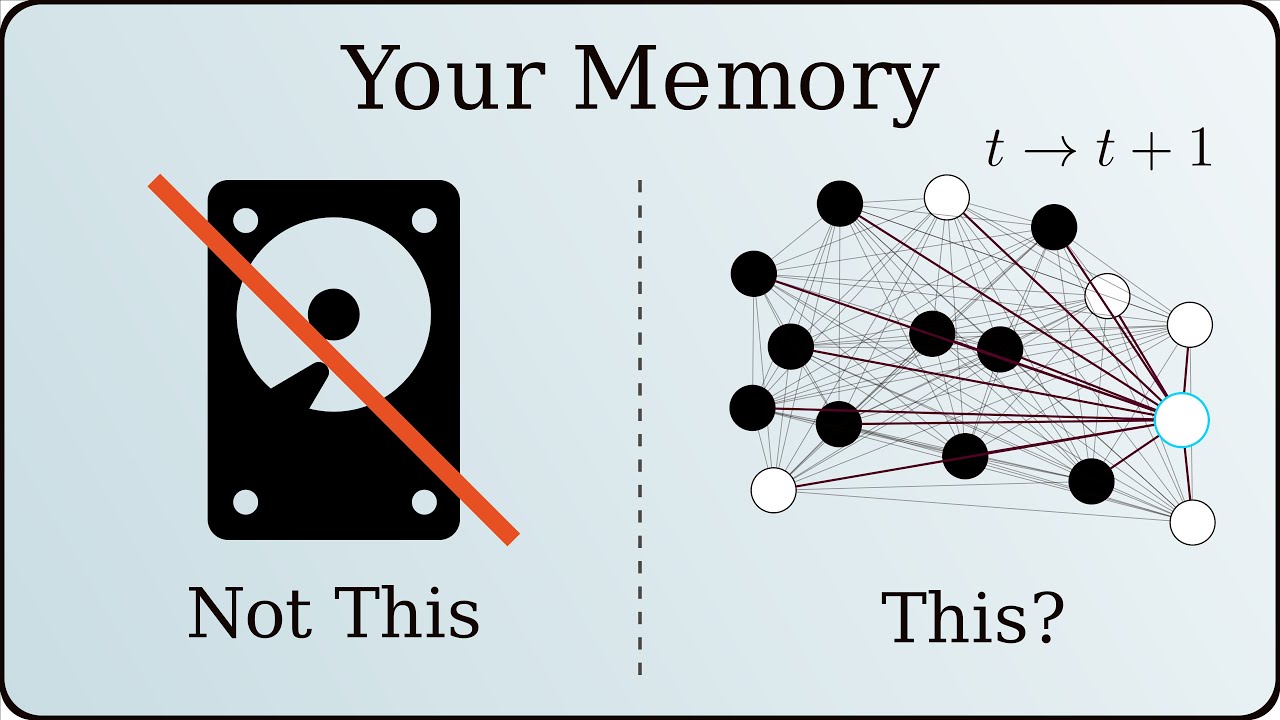
it is a really good video, i recommend it.
point being, neural networks that continuously operate can snap back to well-reinforced states they’ve experience before. If the visual part of your brain sees shapes corresponding to dogs, it may snap into a previously experience state (the sensation of dog). This can combine with the current state of blond-golden-color and a memory section of the brain can snap to any given memory of golden retrievers, which sorta sounds like a train of thought, at least within a half second.
THIS IS ENTIRELY ME TRYING TO MAKE INTUITIVE FACTS ABOUT THE BRAIN WE HAVE NOT YET CONFIRMED… that aside i tend to think i have a decent grasp on this stuff, and cannot wait for science to get a little further, though given how unsure i am about all this, i might not be the first to know lol.
3 Likes
Happy Summer Solstice, everyone!
4 Likes