I hope people like my submission; I am not an artist, so I hope it is “good enough” for the art competition.
Description
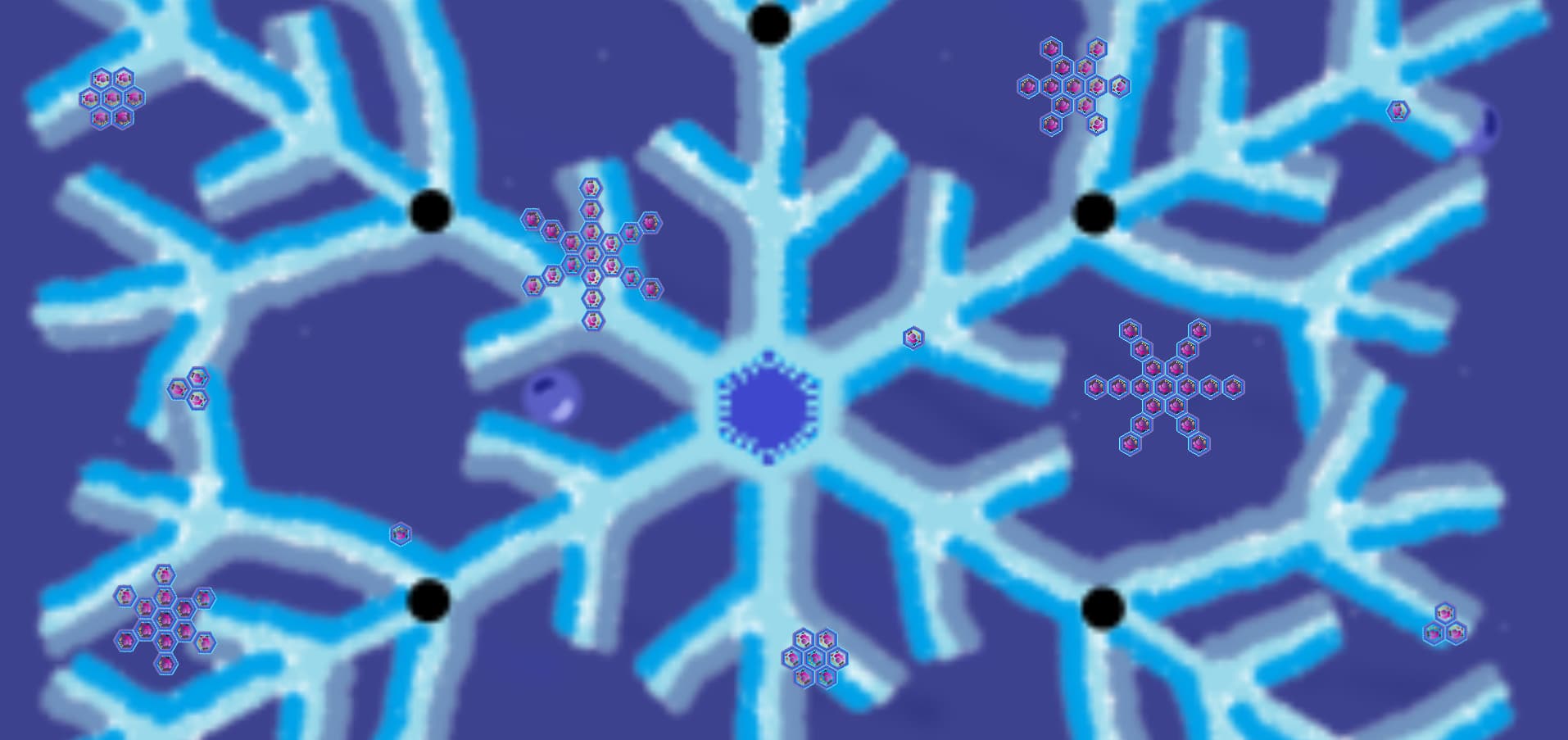
Psychrosquamus plagahamil (Cold-flat plague-bringer) is an Eukaryotic organism with a unique six-sided symmetry. Combined with their unusual reflective properties, Xenobiologists initially mistook these organisms for Snowflakes. Hence for their common name, Snowflake Mimics.
Snowflake Mimics were discovered in the Ragnarök system underneath the ocean of a recently found Dwarf Planet named Jötunheimr. Being named after the home of the Frost Giants in Norse Mythology, this Dwarf Planet is the approximate size of the Earth, but it was located in Ragnarök’s Kuiper Belt. Like Pluto, Jötunheimr has a thick layer of Nitrogen ice tens of miles thick, and beneath that layer of Nitrogen Ice is an even deeper ocean of liquid water. Due to Jötunheimr’s larger mass, the underwater volcanic activity has injected many important chemicals into this vast ocean, such as Iron and Hydrogen Sulfide.
Like on Earth, life began in the ocean. Mixing of Tholins from surface and chemical below created the perfect conditions for life. After the first drilling probe collected samples of water, Psychrosquamus were discovered in the samples.
Characterization of the membrane has found analogs of Cholesterol, which indicates that this organism may be an animal. However, more mature Pyschrosquamus have vestiges of glide-symmetry within their internal structure, far too much compared to Modern Earth Animals. This has given rise to an idea that they are Ediacaran-like organisms.
There are issues with this hypothesis, despite it being popular with regular folk. Unlike Ediacarans on Earth, the mature stage of a Psychrosquamus has eye-like cells high in retinal analogues located on each “arm” of the mature organism. Also, the mature Pyschrosquamus has a clearly delineated orifice with especially-hardened teeth-like cells.
The nature of these teeth-like cells are unlike anything on Earth. The outer shell of these cells is high in iron, similar to the metallic claws of the fictional character Wolverine. Also, these cells secrete a “seed” protein, which helps crystallize ice shards. It is believed this function is for aiding in biting or hooking prey.
A recent video of the organism in vivo has found another reason: locomotion. Like the intracellular bacterial pathogen Listeria using Actin on Earth, other cells within Pyschrosquamus secrete this “seed” protein for propelling itself using localized ice crystallization and decrystallization. Due to the larger size of the mature organism, this process imparts small, but steady locomotion. At smaller scales, this process imparts quite a bit of speed.
Additionally, these organism have a unique anti-freeze protein which allows them to live in the very cold, upper regions of the underwater ocean. This protein is also the reason for the Psychrosquamus unique ice-like shine and color. Iron and sulfur-bearing proteins are concentrated with individual cells, indicate that this may be a potential food source for the ice-lovers. It is also possible that these organelles with iron are used for direction-sensing with the planet’s magentic field.
Psychrosquamus plagahamil is most studied organism of Jötunheimr. During its lifecycyle, “stem” cells are ejected and are taken by currents. If a “stem cell” of Pyschrosquamus plagahamil attaches itself onto another organism, then it uses the host for nutrients. Otherwise, the cell will wander around and grow until it reaches maturity.
A mature Pyschrosquamus plagahamil is about the size the smallest possible Earth insect (0.5 to 1.0 mm). The plagahamil species is named for the fact that it houses toxins within itself, and the disease this toxin inflicts when injected into a host organism. This toxin is also for defense against being eaten, and the toxin possibly has anti-oxidant properties, but this does not stop organisms that have adapted against the toxin from eating it.
For the plagahamil species, it will either consume organisms smaller than itself, incidentally sometimes its own smaller kind, or attach itself to a bigger organism and leach off of it. When the toxin is inject, it slowly kills the host organism. When one mature Pyschrosquamus plagahamil starts to kill its host, after several days, it secrets a factor into the water to attract other Pyschrosquamus plagahamil to also attach/attack the same target. Eventually, the host organism is covered in Snowflake Mimics, which gorge on the dead host. This behavior gave Pyschrosquamus plagahamil the nickname “Flurries of Death”.