Catalog the AI evolved species in your save games and post them here. Observe their behavior, catalog that too.
I did something akin to this when we were still developing 0.4.0.
It will be very fun to see what evolved in everyones saved games
It will be especially helpful/interesting if you catalog novel behavior, like what scarlet seeker saw in his video. Where a species evolved ambush hunting behavior.
This will aid us in improving things in the future. https://youtu.be/xhjr5iAFKuc?t=13886
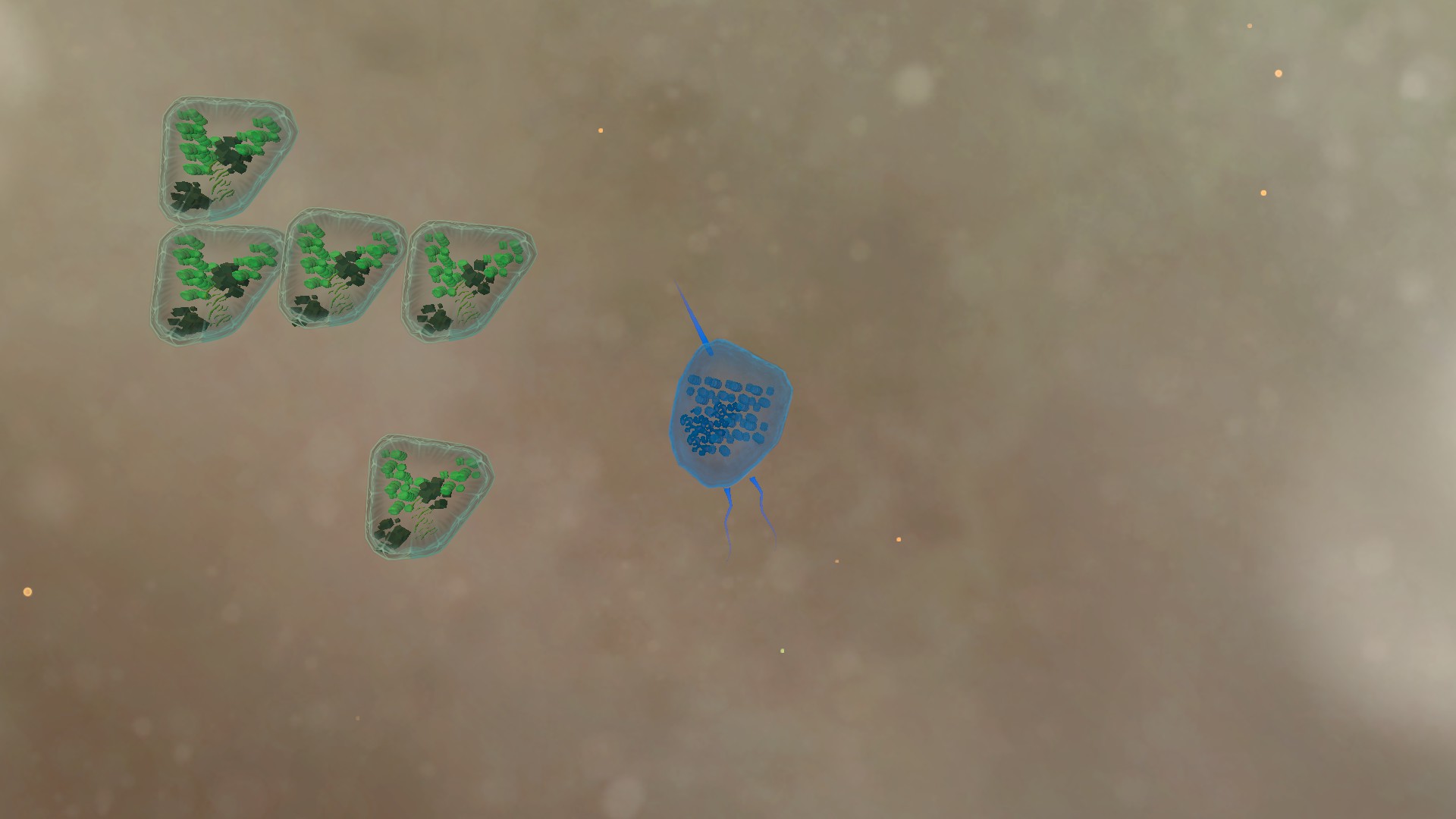
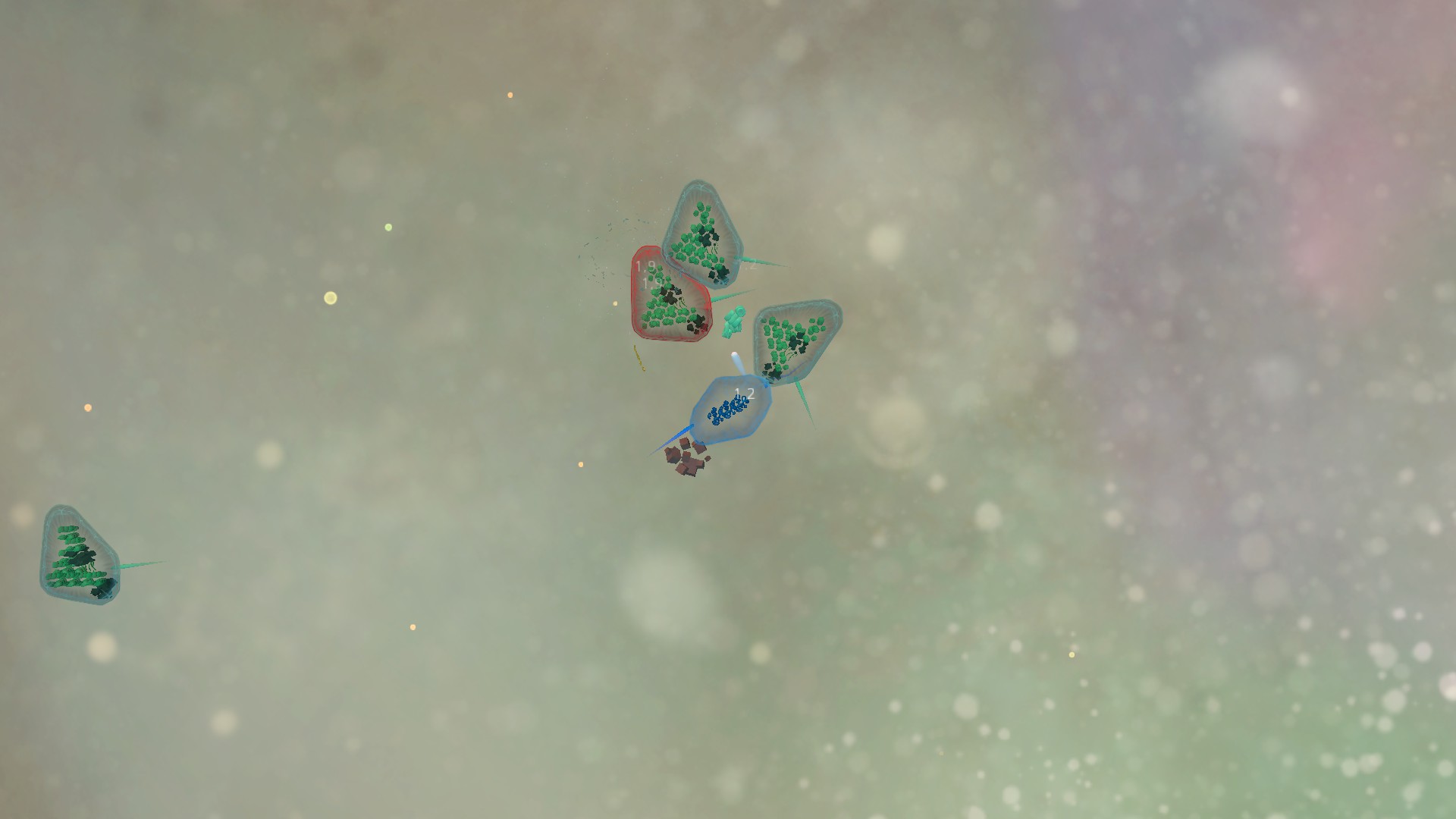
It is nothing very spectacular, but after 1300 Million years (13 editor cycles) of bacterial evolution on one of my playthroughs, I noticed a species called Vruhxes Otappian on the surface biomes. They are photoautotrophs and have a strong silica membrane.
What I found interesting is their extremely sessile (and “brave”) behavior: they seem the bacterial equivalent to plants on Earth. Even though my cell is armed with a pilus, and standing right next to them, they don’t move an inch. When I attack them, sometimes they would flee in the opposite direction for a second or two and then stop again. Other times, they would remain totally still until being killed.
On the subsequent editor session, I could check that they are performing well according to auto-evo. I can see why: even though they are easy prey, there’s plenty of energy available for them in the form of light. Their role on the environment is also very important: they are the main source of glucose for the other species, now that free-floating glucose has almost completely disappeared.
I find it very interesting to observe the complementary roles of “producers” and “consumers” emerge and develop naturally from the evolution algorithm.
EDIT:
After a couple editor cycles, the Vruhxes genus have developed a pilus and seem now more aggressive, sometimes even confronting my cell, being more capable of defending themselves.
I wonder if there are some interesting multicellular offshoots that Players have seen with 1.6.0.0?
aah31415
(The maker of SitF, Radiostrocity, The Lifenote and TGBing; The Second Ascended...; And just maybe a security warning come alive...?)
12
I think we should wait for the even more interesting of those until the next release when microbe species will become able to get to multicellular all by themselves
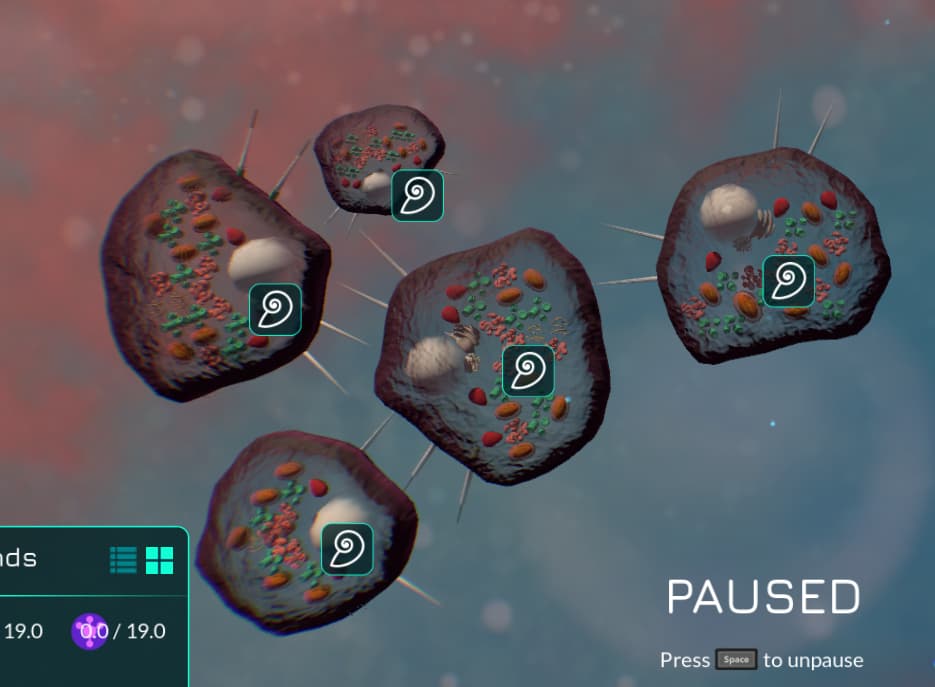
When jetting around as a multicellular, muscular phototroph colony (easily has no need to eat or be attacked, but is still the apex predator, merely because multicellular is overpowered), I found these three species culminating in this one large commune that persisted for quite a long time. Pacanus vepian (the stout orange kind), Atesstir acala (the long orange-yellow kind), and Thanolera fisia (the stout red kind with flaggelum).
a commune crowded around the only environmental resource I care about; phosphate. How inconvenient!
These species are all very similar, almost certainly related, and have a very boring temperament, being maximally passive, fearful, and homebody’d. They all have a pilus on their rear, which is surprisingly effective when being pursued as it damages pursuers. As much as I would have liked to drive them to extinction, they reproduce too fast and provide too little resources, so I got bored of them.
the same commune, multiple evolutions later, despite my attempts to thin them out. They sense no danger.
As for the latest aspiration of multicellular evolutions, I haven’t found any. Perhaps my strategy is so oppressively specialized that it’s impossible to evolve into another miche from my species, and no other species has become multicellular.
Also look at the CO2 concentration :lmao:
1 Like
aah31415
(The maker of SitF, Radiostrocity, The Lifenote and TGBing; The Second Ascended...; And just maybe a security warning come alive...?)
14
Co2 is this high in thrive for photosynthesis to be a viable strat
Looking into it (not a biologist), it appears as though two main solutions were used for the low availability of CO2 in real evolution (“low” compared to Thrive).
In single-celled phototrophs, bicarbonate (much more available in water than diffuse CO2) was brought into the cell, stripped of CO2 by “carbonic anhydrase”, and, by necessity, this stripping had to occur in close proximity to the enzyme “RuBisCO”, which fixes CO2. A “carboxysome” keeps the CO2 in a high concentration around RuBisCO, I think. This is what is useful for Thrive.
In multicellular plants, the main solution was physical/architectural. Plant tissues are, by design, maximized for gas exchange. They are thin, flat, and full of internal air spaces. This is obviously meaningless for current thrive, and I’m sure you already knew this (it’s kinda intuitive), but there are ways that real plants really did survive (and thrive… you could maybe say Thrive) off of far, far lower CO2 concentrations.
What do you think?
aah31415
(The maker of SitF, Radiostrocity, The Lifenote and TGBing; The Second Ascended...; And just maybe a security warning come alive...?)
18
I mean such plants will only soon be coming to Thrive so they still could get these architectural solutions added unto em
At least CO2 is not impacted by Fermentation. According to hhyyrylainen, CO2 would be become heavily imbalanced, and probably make Photosynthesis Super OP.
Mutlicellular Auto-Evo is need of more work, so it probably isn’t your fault.
Literally me almost every playthrough … xD
1 Like
aah31415
(The maker of SitF, Radiostrocity, The Lifenote and TGBing; The Second Ascended...; And just maybe a security warning come alive...?)
20
Will this impact breadmaking in future stages I sure do wonder…