Immune cell mini-game would be hilarious!
1 Like
How would you control such a cell when you’re playing as an entire organism?
That is why I said as a mini-game. It could be even a different optional mode.
1 Like
I don’t think the devs would put in the effort to program that in…
Will Ice Ages be possible? It is believed that a combination of increasing oxygen in the atmosphere, possibly a different atmospheric composition, the lowered output of the Sun at that time, and the formation of a supercontinent on the South Pole blocking warm water circulation, is what triggered Ice Ages in the distant (hundreds of millions to billions of years) past.
From Wikipedia:
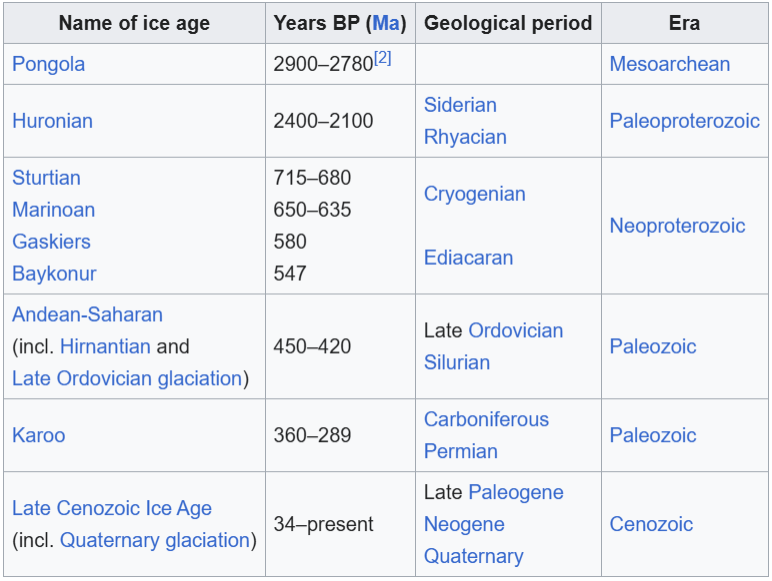
3 Likes
“Global Glaciation Event” is currently scheduled to be added in 0.8.2.
1 Like
Nice. But one major aspect of Ice Ages is that a continent, or supercontinent, blocks/partially blocks ocean currents from the poles to the equator. Also factor in high CO2 levels in the atmosphere, is why we are not currently in an Ice Age, despite having Antarctica over the South Pole. How will Ice Ages in the game be triggered in the distant past if CO2 levels are too high and there is no continental drift at play to put continents in a possibly polar position? Obviously, it would be complicated to include all of this, but Thrive does strive to be as accurate as possible.
3 Likes
I can guess some sort of an algorithm will be put to place if enough demand is put for events like glaciation to be more accurate.
Make sense. I wonder if this will be implemented with Continental Formation/Continental Drift as a separate mechanic?
2 Likes
Maybe continental drift will have an impact to how likely a glaciation event is to begin? Perhaps when the continents and the currents are in the correct spots, the chance of a glaciations occurring is boosted highly?
2 Likes
Perhaps Kinetotrophy could be used by Ediacaran-like organisms in Macroscopic?
2 Likes
Do we have any basis for that?
2 Likes
It has been proposed as a theoretical way to generate energy on Europa. And mechanisms have been proposed for using tides as theoretical energy sources.
From Wikipedia[1]:
Mechanisms
The theoretical mechanics that would allow kinetotrophism vary widely. One pathway proposed by Dirk Schulze-Makuch and Louis N. Irwin involves lever-like proteins that would be moved by the flow of fluid. When inside a protein channel with cilia-like proteins that could act as channel guards, the levers could allow specific molecules into or out of the cell.[4] Harnessing the Gibbs–Donnan effect, sodium ions could be made to enter the cell and fuel a hydrogen transporter similar to those in mitochondria, thus allowing for energy-storing molecules like ATP to be synthesized.[1] This mechanism would act like a battery; thus, only enough time and a flow of fluid in the range of millimetres per second would be required for the synthesizing of complex molecules.[3]
Another mechanism to derive energy from kinetics would be a spring-like structure. Fluid currents or tides could place pressure on cilia structures, bending them and creating tensile energy. When the pressure subsides, that tension would be released and could create usable energy.[2]
Habitat
Kinetotrophs could thrive under the Europan ice sheet or on the moon’s volcanic seafloor.
It has been proposed that kinetotrophs could exist underneath the ice sheet of the Jovian moon Europa. These organisms might attach to the underside of the ice sheet, or to substrates on the ocean floor.[1][5] The kinetic energy these organisms would harness could be provided by convection cells, where currents are created by the varying temperatures of fluid throughout the water column.[3]

3 Likes
This also entirely depends on the will of the developers now more focused on finishing the multicellular asap
1 Like