I wonder if they already noticed that the species went in some strange directions…
Well, there are many other species on Planet Genesis. You can only see the ones on this continent, that are descended from the Ompard. And there are other subspecies and branches of the main species that the players control. There are probably weirder creatures, on the other side of the planet, or even in the same patches as the Ompard descendants…
2 Likes
Do they (the other animal-like species) have a major impact on the player-controlled species?
M1: Better tight junctions minimizes water lost while breathing, making the organism have even higher Drought Resistance.
M2: Fat reserves used for energy and water develop on the underside of the belly and sides of the legs. This increases the drought resistance of the organism even more.
2 Likes
No encountered ones yet, but maybe ones on different continents, or maybe they will become rival civilizations.
1 Like
That certainly doesn’t seem like what humans wanted a terraformed world to end up as - a battleground for society-stage civs…
It’s quite hard to stop creatures from becoming intelligent while still allowing them to adapt to whatever the humans do. The easiest course of action is probably EXTERMINATION.
1 Like
Which might be what they’ll do to the disobedient species…
1 Like
I hope they don’t use our organisms for food. Since Dinosaurs are related to Avians like Chickens, and apparently Crocodile meat tastes like Chicken, Dinosaur meat probably also tasted like Chicken. What do the Ompards taste like?
2 Likes
There’s only one way to find out…
1 Like
Probably also chicken, if both dinosaur and crocodile meat tastes like chicken. I think iguanas also taste like chicken.
1 Like
Let’s hope we don’t end up as “Ompard Nuggets”…
1 Like
Why does it feel like something that McDonalds would actually make?
2 Likes
Not sure, maybe they’ll open up a restaurant at “Genesis”…
2 Likes
Round 10
@Cha @willow @aah31415 @AnthropocenianAge
The world
97% Complete…
The Drought
Over time, the Drought only got worse. Many Creatures died, unable to find food or water. There was no hope…
Lake A Becomes Dried-up Lakebed A
False Salamander: No extra food from eggs/endosymbiosis in temperate patches.
All creatures: -6 Sustainable population (increases each round)
The Fungus
The Fungus has now completely eradicated.
Fungus Health: 0/9 (-1 per round, -1 per immune system mutation)
The Fungus lowers your sustainable population depending on it’s health (9-7 is 3, 6-4 is 2, 3-1 is 1, 0 is 0)
Immune systems reduce The Fungus’s health, and reduces it’s damage to you by 1.
All creatures: - sustainable population.
Creatures
cha - Greater Ompard
A large grazer, with complex mating rituals using ultraviolet plumage.
The Greater Ompard’s Population is growing exponentially, now evolving an even larger fermentation stomach (+1 Foraging) to consume vegetation easier. It also gained improved smell, allowing it to detect food and water easier (+1 drought resistance).
Massive Herbivore (Foraging Level 8)
Stats:
-
Movement: 5*0.5 = 3 (Swimming 1) (Mud Walking 1)
-
Strength: 1*1.5 = 2
-
Stealth: 2
-
Intelligence: 1 (Tier 0)
Feeds on: Vegetation
Hunted by:
Suited for: Plains, Forest, Jungle, Swamp, Lake, Desert, Dried-up Lakebed
Population: 37.6
Sustainable population: 37.6 (+40.6 from food, -0 from the Fungus, -3 from the Drought)
Distribution: Plains A = 1.4, Plains B = 1.4, Plains C = 1.4, Plains D = 4, Forest A = 1.8, Forest B = 1.8, Forest C = 5, Jungle A = 2.7, Jungle B = , Jungle C = 2.7, Lake C = 0.9, Swamp A = 2.7, Swamp C = 2.7, Desert A = 2, Desert B = 2, Desert C = 2, Desert D = 2, Dried-Up Lakebed = 1.4
Mutations:
Stats:
-
broad circular feet to spread the weight evenly out and not sink into the ground (+1 Mud Walking)
-
Air sacs for swimming (+1 Movement, +1 Swimming)
-
Hollow bones (+1 Movement)
-
Unidirectional Air System (+1 movement)
*Throat sacs (+1 Movement)
*Ultraviolet vision (+1 Stealth)
-
Tusks (+1 Strength)
-
Nervous system (+1 Intelligence)
-
Legs (+1 Movement)
-
Eyes (+1 Stealth)
Size
-
Bigger size (Massive size)
-
Large plumage (Large size)
-
Medium Size
Diet
-
Larger Fermentation stomach (+1 Foraging)
-
Larger Fermentation stomach (+1 Foraging)
-
Longer neck (+1 Foraging)
Longer neck (+1 Foraging)
-
Conical teeth (+1 Foraging)
-
Longer neck (+1 Foraging)
*Fermentation stomach (+1 foraging)
-
Herbivorous Diet
-
Longer Intestines (+1 Foraging)
Environmental Adaptions
-
Improved smell (+1 drought resistance)
-
Leathery feet that can walk on hot sand (+1 Heat Resistance)
-
A coat that defects heat during the day and keeps it in during the night (+1 Heat Resistance)
-
More water in hump (+1 Drought Resistance)
-
Flaps beneath the head to increase surface area and cool down (+1 Heat Resistance)
-
Hump/fat storage to endure harsh times without food and water (+1 Drought Resistance)
-
Thicker Skin (+1 Humidity Resistance)
-
Temperate Climate Adaption
Willow - Pecuarius falsalamandra - False Salamander
An amphibious reptile that looks like a salamander. Lays slimy eggs that can digest food.
Medium Herbivore (Foraging Level 2)
The False Salamander has expanded it’s bioluminescence capability, gaining infrared bioluminescent (cosmetic). It also now has Lumenoplasts and Photoplasts on each axiom, allowing it to think at the speed of light (+1 Intelligence). Lastly, it evolved thicker fat to withstand the cold of the sea. (+1 cold resistance)
Stats:
-
Movement: 8*1 = 8 (Swimming 5) (Climbing 1)
-
Strength: 1*1 = 2
-
Stealth: 2*1 = 2
-
Intelligence: 2 (Tier 0)
Feeds on: Vegetation,
Hunted by:
Suited for: Plains, Lake, Forest, River, Dried-up Lakebed, Coast
Population: 23.6
Sustainable population: 23.6 (+26.6 from food, -0 from the Fungus, -3 from the drought)
Distribution: Plains A = 0.4, Plains B = 0.4, Plains C = 0.4, Lake B = 2.5, Lake C = 2.25, Forest A = 0.5, Forest B = 0.5, River A = 2.75, River B = 2.25, River C = 2.25, Coast A = 4, Coast B = 4, Coast C = 4, Dried-Up Lakebed A = 0.4
Mutations:
Stats:
-
Lumenoplasts and Photoplasts on each axiom to think at the speed of light (+1 Intelligence)
-
Endosymbiosis a microbe with bioluminescence, to communicate and warn each other of hiding predators (+1 stealth)
-
Durable claws for burrowing underwater (+1 Movement, +1 Swimming)
-
Lung cells produce lots of myoglobin (+1 Movement, +1 Swimming),
-
Better Swimming Muscles (+1 Swimming, +1 Movement)
-
Pointy teeth (+1 Strength)
-
Sticky feet (+1 Movement, +1 Climbing)
-
Swimming tail (+1 Movement, +1 Swimming)
-
Swimming legs (+1 Movement, + 1 Swimming)
-
Lung sacs (+1 Movement)
-
Tusks (+1 Strength)
-
Nervous system (+1 Intelligence)
-
Legs (+1 Movement)
-
Eyes (+1 Stealth)
Size
- Medium Size
Diet
-
Instinct to lay eggs on moss and algae (+1 Foraging)
-
Herbivorous Diet
-
Longer Intestines (+1 Foraging)
Environmental Adaptions
-
Thicker fat to withstand the cold (+1 cold resistance)
-
Tubes to supply ammonia to amnioplasts, and take water back into the blood (+1 Drought Resistance)
-
Small external gills to hydrate faster in water (+1 Drought Resistance)
-
A wax layer that can be shed after spending an hour underwater (+1 Drought Resistance)
-
Temperate Climate Adaption
Egg
-
Sync the cell cycles of the chloroplasts with the cells. and have them specialize into amino acid factories and nitroplasts when not exposed to light (+0.25 food per humid, temperate or aquatic patches)
-
Fins running down the sides of the torso, increasing surface area exposed to light (+0.25 food per humid, temperate or aquatic patch)
-
Endosymbiosis an algae Endosymbiosis a small algae (+0.25 food per humid, temperate or aquatic patch)
-
Ditch sexual different ion (+0.25 food per humid, temperate or aquatic patch.)
-
Ability to lay eggs in small pockets of water (+0.25 food in temperate humidity and +0.5 food in humid humidity)
-
Thin, sticky egg membrane + phagocytic eggs (+1 food in aquatic patches, slight chance of endosymbiosis)
aah31415 - Pecuarius Maxillaavis - Two-Headed Ompard
An aerial, duel-headed scavenger.
In order to combat the Drought the Two-Headed Ompard gained more cytoplasm in it’s cells, to store more water. (+1 Drought Resistance). It is also more intelligence now, close to Tier 1. (+1 Intelligence)
Medium Herbivore/Scavenger (Foraging Level 7)
Stats:
-
Movement: 6*1 = 6 (Flight 4)
-
Strength: 1*1 = 1
-
Stealth: 3*1 = 3
-
Intelligence: 4 (Tier 0)
Feeds on: Vegetation, Scavenged Corpses
Hunted by:
Suited for: Plains, Forest, Dried-up Lakebed
Population: 10
Sustainable population: 10 (+13 from food, -0 from the Fungus, -3 from the drought)
Distribution: Plains A = 2, Plains B = 2, Plains C = 2, Forest A = 2.5, Forest B = 2.5, Dried-Up Lakebed = 2
Mutations:
Stats:
-
More Intelligence (+1 Intelligence)
-
Proto-feathers become closer to normal feathers (+1 flight, +1 movement)
-
More intelligence (+1 Intelligence)
*Proto-feathers (+1 flight, +1 movement)
-
Organ for smell (+1 stealth)
-
Better Eyesight (+1 Stealth)
-
Wings for flight X 2 (+2 movement, +1 flight)
-
More neurons (+1 intelligence)
-
Better heart (+1 Movement)
-
Tusks (+1 Strength)
-
Nervous system (+1 Intelligence)
-
Legs (+1 Movement)
-
Eyes (+1 Stealth)
Size
- Medium Size
Diet
-
Longer neck (+1 Foraging)
-
Rudimentary grasping limbs (+1 Foraging)
-
Grinding teeth (+1 Foraging)
-
Fermentation Stomach (+1 Foraging)
-
Separate digestive tracts X 2 (+2 foraging)
-
Herbivorous Diet
-
Longer Intestines (+1 Foraging)
Scavenging
-
Scavenging beak (+0.25 food per patch)
-
Different heads for scavenging (+0.5 food per patch)
Environmental Adaptions
-
More Cytoplasm (+1 Drought Resistance)
-
Mesothermy (+1 Cold Resistance)
-
Temperate Climate Adaption
Immune System:
- Basic Immune system (-1 pop damage from The Fungus)
AnthropocenianAge - Precuarius taurum - Bull Ompard
A stealthy, horned forager.
The Bull Ompard is fighting tooth and nail to resist the Drought, now only having minimal water waste when breathing (+1 Drought Resistance), and much greater fat reserves (+1 Drought Resistance).
Medium Herbivore (Foraging Level 6)
Stats:
-
Movement: 6*1 = 6 (Swimming 3) (Mud walking 1)
-
Strength: 2*1 = 2
-
Stealth: 3
-
Intelligence: 1 (Tier 0)
Feeds on: Vegetation
Hunted by:
Suited for: Plains, Lake, Swamp, Forest, Jungle, Rivers, Dried-Up Lakebed
Population: 17.35
Sustainable population: 17.35 (+18.35 from food, -0 from the Fungus, -1 from the Drought)
Distribution: Plains A = 1, Plains B = 1, Plains C = 1, Lake B = 1.5, Lake C = 0.8, Swamp A = 2.3, Swamp C = 2.75, Forest A = 1.2, Forest B = 1.2, Jungle A = 2.3, Jungle B = 2.3, Dried-Up Lakebed A = 1
Mutations:
Stats:
-
Mud walking (+1 movement, +1 mud walking)
-
Webbed feet (+1 swimming, +1 Movement)
-
An extra tail to warn and communicate (+1 stealth)
-
An extra pair of legs (+1 Movement)
-
Eyes on the top of it’s head (+1 stealth)
-
Bull horns (+1 strength)
-
Tusks (+1 Strength)
-
Nervous system (+1 Intelligence)
-
Legs (+1 Movement)
-
Eyes (+1 Stealth)
Size
- Medium Size
Diet
-
Longer Neck (+1 Foraging)
-
Longer Neck (+1 Foraging)
-
Longer Neck (+1 Foraging)
-
Ruminant Chamber to the left of the the main stomach (+1 Foraging)
-
More teeth (+1 Foraging)
-
Herbivore teeth (+1 Foraging)
-
Herbivorous Diet
-
Longer Intestines (+1 Foraging)
Environmental Adaptions
-
Minimal Water Waste when breathing (+1 Drought Resistance)
-
More Fat reserves (+1 Drought Resistance)
-
Absorbs more water in dry climates, producing solid urine (+1 Drought Resistance)
-
Longer intestines absorb more water (+1 Drought Resistance)
-
Mucous secretion (+1 Humidity resistance)
-
Instinct to create mud wallows (+1 Heat resistance)
-
Temperate Climate Adaption
Immune
-
Innate Immune system (-1 pop damage from The Fungus)
-
Adaptive Immune system (-1 damage from the Fungus)
Patches
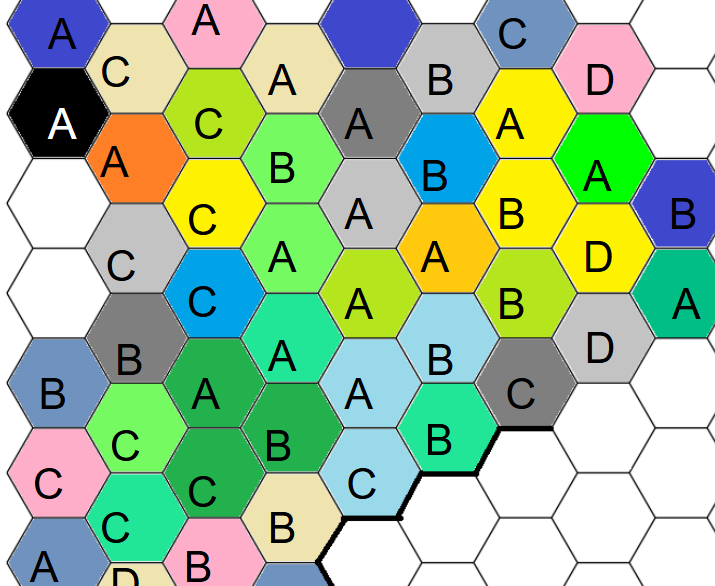
Key
Pale Green-Yellow: Plains
Light Grey: Cliffs
Light Green: Forest
Teal Green: Swamp
Light Blue: River
Blue: Lake
Yellow: Desert
Dark grey: Mountains
Dark green: Jungle
Light Beige: Coast
Light Pink: Coral Reef
Dark Orange: Snow Fields
Light Orange: Dried-up lakebed
Blue Grey: Open Ocean
Dark Blue/ Indigo: Depths
Black: Sea Ice
Seaweed Green: Seaweed Forest
New patches
Depths
The Deep Sea.
Needs: Swimming 15, Cold Resistance 5, pressure Resistance 5
Unexplored
Sea Ice
Vast sheets of ice,
Needs: Swimming 10, Cold Resistance 10
Unexplored
Seaweed Forest
A forest of Kelp.
Needs: Swimming 10, Cold Resistance 1
Unexplored
Explored patches
Plains A
Food: 4 Vegetation
Creatures: Greater Ompard (1.4), False Salamander (0.4), Two-Headed Ompard (2), Bull Ompard (1)
Plains B
Food: 4 Vegetation
Creatures: Greater Ompard (1.4), False Salamander (0.4), Two-Headed Ompard (2), Bull Ompard (1)
Plains C
Food: 4 Vegetation
Creatures: Greater Ompard (1.4), False Salamander (0.4), Two-Headed Ompard (2), Bull Ompard (1)
Lake B
Food: 2 Vegetation, 3 Fish (Meat)
Creatures: False Salamander (2.5), Bull Ompard (1.5)
Lake C
Food: 2 Vegetation, 3 Fish (Meat)
Creatures: Greater Ompard (1), False Salamander (2.25), Bull Ompard (0.8)
Swamp A
Food: 5 Vegetation
Greater Ompard (2.7), Bull Ompard (2.3)
Swamp C
Food: 5 Vegetation
Greater Ompard (2.7), Bull Ompard (2.3)
Forest A
Food: 5 Vegetation
Greater Ompard (1.8), False Salamander (0.5), Two headed Ompard (2.5), Bull Ompard (1.2)
Forest B
Food: 5 Vegetation
Greater Ompard (1.8), False Salamander (0.5), Two headed Ompard (2.5), Bull Ompard (1.2)
Forest C
Food: 5 Vegetation
Creatures: Greater Ompard (2.8), Bull Ompard (2.3)
Jungle A
Food: 6 Vegetation
Creatures: Greater Ompard (2.7), Bull Ompard (2.3)
Jungle B
Food: 6 Vegetation
Creatures: Greater Ompard (2.7), Bull Ompard (2.3)
Jungle C
Food: 6 Vegetation
Creatures: Greater Ompard (2.7), Bull Ompard (2.3)
River A
Food: 3 Vegetation, 3 Fish (Meat)
Creatures: False Salamander (2.75), Bull Ompard (2.25)
River B
Food: 3 Vegetation, 3 Fish (Meat)
Creatures: False Salamander (2.75), Bull Ompard (2.25)
River C
Food: 3 Vegetation, 3 Fish (Meat)
Creatures: False Salamander (2.75), Bull Ompard (2.25)
Desert A
Food: 2 Vegetation
Creatures: Greater Ompard (2)
Desert B
Food: 2 Vegetation
Creatures: Greater Ompard (2)
Desert C
Food: 2 Vegetation
Creatures: Greater Ompard (2)
Desert D
Food: 2 Vegetation
Creatures: Greater Ompard (2)
Dried-Up Lakebed A
Food: 4 Vegetation
Creatures: Greater Ompard (1.4), False Salamander (0.4), Two-Headed Ompard (2), Bull Ompard (1)
Coast A
Food: 2 Vegetation
Creatures: False Salamander (4)
Coast B
Food: 2 Vegetation
Creatures: False Salamander (4)
Coast C
Food: 2 Vegetation
Creatures: False Salamander (4)
I advise trying to reach Tier 1 within the next 2-6 rounds…
Also, Sorry it took so long for the Round the come out.
2 Likes
M1: Increased amount of blood vessels in the brain, increasing nutrients to neurons and increasing intelligence, as well as helping the brain to cool off in hotter weather (heat resistance)
M2: Nose becomes bigger to allow cooling in hotter environments without losing moisture.
2 Likes
You can only pick either Cold Resistance or Heat Resistance. Which one do you want?
2 Likes
I will pick heat resistance. I also edited the second part of the second sentence to include less moisture loss instead.
2 Likes
M1: More cooperation between the two-headed leads to a major intelligence increase (does this give me tier 1?)
M2: Lung Upgrade
1 Like
It will bring you up to intelligence 5, but 1 more mutation is needed for Tier 1.
1 Like